Repairing vs. Replacing Commercial Rooftop HVAC Units Before Arizona's Winter
Repairing vs. Replacing Commercial Rooftop HVAC Units Before Arizona's Winter
Facility managers have a brief window this fall to evaluate aging RTUs that struggled through summer. Use this framework to decide whether to repair or replace your system before the cold hits.
Why Fall is the Critical Window for Commercial HVAC Decisions
Before the first true cold snap hits the Valley, there is a brief, critical window of opportunity. You are likely dealing with the aftermath of a brutal summer, where an aging commercial rooftop unit (RTU) required multiple patch repairs just to keep the building habitable. Now, as the seasons shift, facility managers face a crucial decision regarding repairing vs. replacing commercial rooftop HVAC units before Arizona's winter. Weighing the risk of emergency winter downtime against the operational advantage of an October replacement is not just a maintenance task—it is a major business continuity strategy.
If you are managing the comfort and safety of a facility, navigating this choice requires expert guidance and reliable commercial HVAC services to ensure your operations never miss a beat.
The transition period between peak cooling and heavy heating is notoriously tough on commercial systems. Components that have been heavily taxed for months are suddenly asked to reverse their operation or engage dormant heating elements. Heat exchangers that sat idle while the air conditioning ran nonstop are now subjected to rapid thermal expansion, exposing microscopic cracks that can compromise safety. Reversing valves in heat pumps can stick after months of single-direction operation. Because the mild October weather in Avondale provides a rare period of low thermal load on your building, this is the exact moment to evaluate your system's health without exposing your tenants, inventory, or employees to extreme indoor temperatures.
Making this choice requires a strategic framework rather than a simple, reactive cost-comparison. Waiting for a complete failure in January means scrambling for emergency service, paying premium rates for rushed equipment delivery, and dealing with angry occupants. Proactive planning right now allows you to control the timeline, secure the right equipment, and protect your bottom line.
Assessing the Summer Toll on Your Commercial RTU
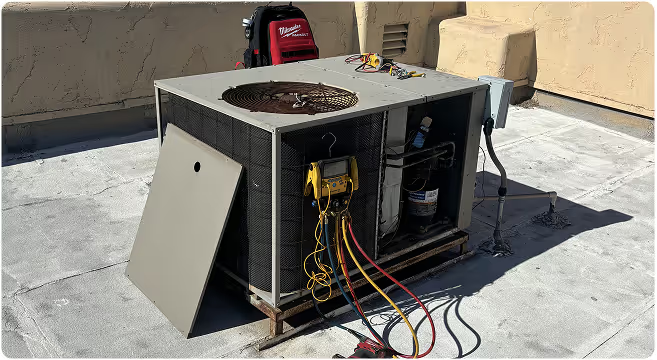
To understand why a system might fail in December, you have to look at what it endured in July. The intense thermal loads and relentless UV exposure across Avondale commercial properties severely degrade commercial rooftop equipment over time. A unit that technically "survived" the summer often limps into the fall with compromised internal components that are highly susceptible to failure once the heating season begins.
Facility managers should conduct a thorough review of their system's recent history using these critical assessment steps:
1. Review the maintenance log: Count the number of service calls made between May and September. Multiple visits for the same recurring issue indicate a systemic failure rather than a fluke component breakdown.
2. Evaluate temporary patch repairs: Often, technicians must perform rapid fixes during peak cooling season just to restore airflow. These "band-aid" solutions—like topping off refrigerant without fixing the underlying leak—leave the system vulnerable when switching to heating.
3. Inspect for thermal and UV degradation: The intense Arizona sun bakes the wiring, belts, and insulation on rooftop units. Brittle wiring and cracked belts are prime candidates for snapping when the temperature drops.
4. Analyze compressor stress: The compressor is the heart of your RTU. If it ran continuously without cycling off during the hottest weeks, the internal wear and tear is immense, drastically increasing the risk of a seized motor during the winter transition.
The specific risks of winter heating failures multiply after a system has been heavily stressed. A cracked heat exchanger, for instance, not only stops providing warmth but can also introduce dangerous combustion gases into the building's air supply. By proactively preventing common HVAC problems year-round, you can identify these compounding issues before they turn into full-scale operational disasters.
When Does Repairing Make Strategic Sense?
Replacing a commercial rooftop unit is a significant capital investment, and there are absolutely scenarios where repairing the existing equipment is the most logical, fiscally responsible choice. The key is knowing how to differentiate between a worthwhile repair and throwing good capital after bad equipment.
Here is when keeping your current system operational makes the most strategic sense for Avondale commercial properties:
• The 50% Rule applies: A standard industry benchmark dictates that if the cost of the repair is less than half the total cost of a new system, and the unit is relatively young, repairing is usually the right move. If the repair costs creep above that halfway mark on an aging unit, the return on investment plummets.
• The unit is well under its life expectancy: Commercial RTUs typically last 15 to 20 years. If your system is only seven or eight years old and has been properly maintained, a major repair is generally a safe investment because the unit still has a decade of productive life ahead.
• The failure is isolated: When a breakdown is traced to a single, easily replaceable component—like a faulty contactor, a blown capacitor, or a worn fan belt—repairing it is the obvious choice. This is vastly different from a systemic failure involving a burned-out compressor or a leaking evaporator coil.
• You have a pristine maintenance history: Systems that have received regular, documented preventative maintenance are much better candidates for repair. Their overall structural integrity is sound, making a targeted fix highly effective.
When you determine that a strategic repair is the right path, having a reliable partner for immediate, precise fixes is non-negotiable. Securing professional emergency AC repair ensures that the component is replaced correctly the first time, preventing secondary damage to the rest of the unit and keeping your facility running smoothly as the seasons change.
Signs It is Time to Replace Your Commercial RTU Before Winter
There comes a point where repairing an aging rooftop unit becomes a liability rather than a cost-saving measure. Recognizing the indicators of imminent failure allows you to leverage the mild October weather in Avondale for a planned, orderly installation. If you notice several of these warning signs, it is time to move forward with a replacement.
• The unit has exceeded its 15-to-20-year life expectancy: Even with perfect maintenance, the mechanical components of an RTU degrade over two decades of constant operation. Past this window, efficiency drops off a cliff and catastrophic failures become highly probable.
• Frequent, compounding repairs disrupt operations: If you are calling for service every few months, the downtime is costing your business more than just the repair bill. Lost productivity, uncomfortable tenants, and compromised inventory add up quickly.
• The system relies on phased-out R-22 refrigerant: R-22 is no longer manufactured or imported. If your older unit develops a leak, sourcing recycled R-22 is prohibitively expensive, making repairs increasingly unfeasible and financially reckless.
• Energy bills have spiked significantly: A sudden, unexplained increase in your facility's energy consumption is a massive red flag. It means the unit is working twice as hard to produce the same amount of heating or cooling, signaling failing internal components.
• Inconsistent indoor air quality and temperature: If certain zones of your building are freezing while others are stuffy, or if humidity levels are fluctuating wildly, the RTU is no longer capable of managing the building's thermal load.
When these symptoms align, the most strategic move is to schedule a commercial AC replacement in Avondale before winter weather forces an emergency shutdown.
The Operational Advantage of October Changeouts
Logistics play a massive role in commercial HVAC management. Unlike residential systems, swapping out a commercial rooftop unit is a complex engineering feat that involves heavy machinery, structural considerations, and significant coordination. October's climate provides the perfect operational window between the extreme summer heat and the winter heating season to execute this work.
Lower Cooling Demands Minimize Disruption
During the mild October weather in Avondale, your building's thermal load is at its lowest point of the year. This means that temporarily shutting down the HVAC system for a changeout will not result in the indoor temperature skyrocketing to dangerous levels within an hour. You can comfortably keep tenants and employees inside the building while the work is performed overhead, ensuring business continuity.
Safer Crane Logistics and Roof Work
Lifting a multi-ton HVAC unit onto a commercial roof requires a crane, clear weather, and safe wind speeds. The calm, temperate fall weather provides the ideal conditions for heavy lifting. Furthermore, opening up the roof envelope to transition ductwork and curbs is significantly safer when you aren't battling monsoon rains or blistering summer sun.
Preventing Emergency Winter Downtime
Planned replacements prevent the nightmare scenario: a total system failure during peak holiday business hours or a mid-winter cold snap. Emergency replacements often face delays due to equipment availability and rushed permitting. Proactive scheduling ensures the exact right equipment is sourced and ready.
This is where partnering with the right team matters. Tortoise Heating and Air's prompt, reliable commercial expertise ensures that complex changeouts are executed with minimal downtime. Their team understands the logistical intricacies of commercial spaces, coordinating crane lifts and system integrations seamlessly so your business operations barely notice the transition.
Evaluating Energy Efficiency and Long-Term ROI
Bridging the gap between immediate operational logistics and long-term facility strategy requires a close look at energy efficiency. Modern commercial HVAC technology has advanced rapidly, meaning a new unit offers substantial improvements over equipment manufactured just ten or fifteen years ago.
When comparing older units to modern systems, the most critical metric for Avondale commercial properties is the Integrated Energy Efficiency Ratio (IEER). Unlike older SEER ratings that only measured efficiency at peak load, IEER measures how efficiently a commercial system operates under partial loads—which is how RTUs run the vast majority of the time. Upgrading to a high-IEER system dramatically reduces the electrical draw required to condition your building, translating directly into lower monthly overhead.
Beyond raw electrical efficiency, a new commercial rooftop unit drastically improves indoor air quality (IAQ) for tenants and employees. Modern systems feature advanced variable-speed blowers and superior filtration capabilities that manage humidity and filter out particulates much more effectively than aging units. This creates a healthier, more productive indoor environment.
Furthermore, modern systems are designed to align with strict Department of Energy (DOE) and ASHRAE guidelines for commercial buildings, ensuring your facility remains compliant with current environmental and safety standards. While exploring an upgrade, it is also wise to consult with your utility provider or a tax professional, as generally applicable energy rebates or tax credits may be available for high-efficiency commercial upgrades, helping to offset the initial capital expenditure.
Comparing Business Continuity Risks: Repair vs. Replace
Ultimately, the decision framework synthesizes down to a side-by-side comparison of risks and rewards. The short-term appeal of repairing an aging unit must be weighed against the long-term stability and operational predictability of replacing it. For facility managers, the true metric is business continuity. The hidden cost of emergency downtime—lost sales, halted production, and tenant compensation—often heavily outweighs the upfront investment of a planned replacement.
Here is how the two paths compare when evaluating the impact on Avondale commercial properties:
• Initial Capital Outlay — Strategic Repair Path: Lower immediate cost, preserving current quarterly budget. — Proactive Replacement Path: Higher upfront investment, but locks in predictable long-term costs.
• Business Continuity Risk — Strategic Repair Path: High risk of subsequent failures if the unit is older than 15 years. — Proactive Replacement Path: Virtually eliminates the risk of emergency winter downtime.
• Logistical Impact — Strategic Repair Path: Fast turnaround, but may require repeated visits. — Proactive Replacement Path: Requires crane coordination, but leverages mild fall weather for minimal disruption.
To evaluate your current risk level, use this quick facility checklist:
• Age: Is the unit approaching or past the 15-year mark?
• History: Has the unit required more than two significant repairs in the last 12 months?
• Criticality: Would a 48-hour total shutdown in December severely impact your revenue or tenant safety?
• Refrigerant: Is the unit still running on obsolete R-22?
If you answer "yes" to two or more of these questions, replacement is strongly advised. Regardless of your final decision, establishing a structured upkeep plan is mandatory to protect your investment. Committing to a routine HVAC maintenance plan ensures that whether you have a brand-new system or a carefully repaired older unit, it receives the proactive attention required to survive the changing seasons.
The Strategic Framework: Repair vs. Replace for Commercial RTUs
Frequently Asked Questions About Commercial Rooftop HVAC Units
How long do commercial rooftop HVAC units last?
Commercial rooftop HVAC units typically last 15 to 20 years with proper, documented maintenance. However, this lifespan can be significantly shorter in regions that experience extreme thermal loads, as the intense heat accelerates wear on critical components. Regular preventative maintenance is the single biggest factor in reaching the 20-year mark.
Is it worth repairing an old commercial HVAC system before winter?
It is only worth repairing an old commercial HVAC system before winter if the repair cost is relatively low, the unit is under 15 years old, and it has a highly reliable service history. Heavily patched systems that struggled through the summer are high-risk candidates for winter failure. If the unit required multiple fixes recently, investing in a replacement is much safer.
When should a commercial AC be replaced?
A commercial AC should be replaced when repair costs exceed 50% of the replacement value, or when the unit still relies on phased-out R-22 refrigerant. Additionally, if frequent breakdowns are actively disrupting business operations or causing energy bills to spike, a proactive replacement is the most cost-effective business decision.
How does fall weather impact commercial HVAC installation?
Mild fall weather allows for significantly safer crane operation and roof access, which are required for lifting heavy commercial units. Furthermore, swapping a unit during temperate weather prevents extreme temperature exposure inside the building during the transition. This ensures that tenants and employees remain comfortable while the HVAC system is temporarily offline.
What is the 50% rule for commercial HVAC repairs?
The 50% rule is a standard guideline stating that if a required repair costs more than half the total expense of installing a brand-new system, you should opt for replacement. This rule helps facility managers avoid sinking capital into aging equipment that will likely fail again in the near future, ensuring a better long-term return on investment.
Secure Your Facility's Comfort Before Winter Arrives
Evaluating your commercial RTU's reliability, age, and repair history right now is the most effective way to prevent emergency winter downtime. Taking action during the mild October weather in Avondale gives you the operational upper hand. Don't wait for a total system failure to force your hand—reach out to our trusted local experts today to book a comprehensive consultation or replacement estimate and secure your facility's comfort for the seasons ahead.
Our customers consistently share how our dependable service, clear communication, and quality workmanship make us their trusted choice for home comfort.
Discover our latest articles packed with tips, insights, and expert advice for your HVAC needs.
HOME
What Constitutes a True HVAC Emergency During Avondale's Cooler Months?
When your heater won't start on a chilly October night, you need to know if it's safe to wait until morning. Learn to spot real safety hazards versus minor startup quirks.
Repairing vs. Replacing Commercial Rooftop HVAC Units Before Arizona's Winter
Facility managers have a brief window this fall to evaluate aging RTUs that struggled through summer. Use this framework to decide whether to repair or replace your system before the cold hits.
The Mechanical Toll of Skipping End-of-Summer AC Coil Cleaning
Monsoon season leaves baked-on debris coating your AC condenser. Before letting that grime sit dormant all winter, see why post-season cleaning is essential to prevent severe mechanical strain.
Why Your Heat Pump Smells Like Burning Dust When Switching to Heat
Turning on your heating system for the first time this fall shouldn't cause panic. Find out what causes that alarming smoky odor and how to tell a normal seasonal burn-off from a real hazard.


.avif)

.avif)

.avif)