The Mechanical Toll of Skipping End-of-Summer AC Coil Cleaning
The Mechanical Toll of Skipping End-of-Summer AC Coil Cleaning
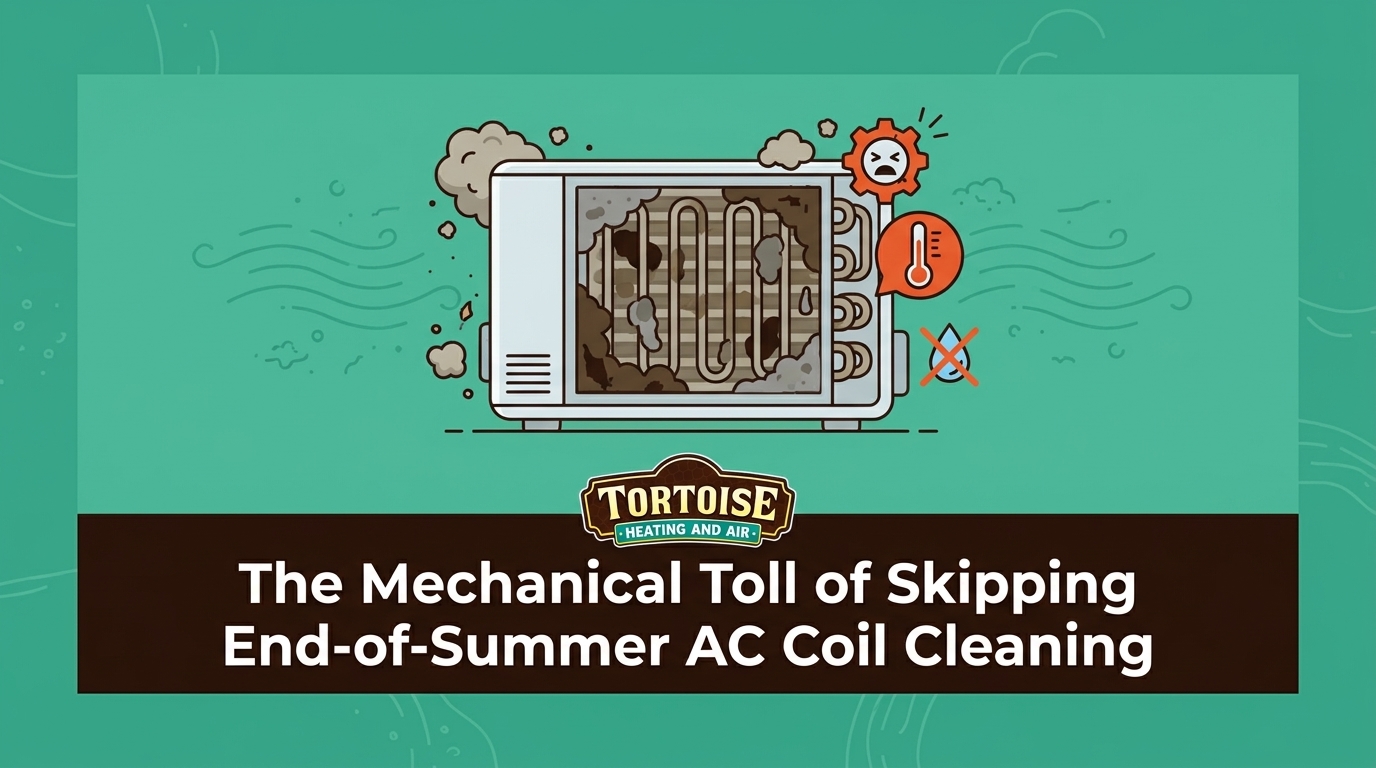
Monsoon season leaves baked-on debris coating your AC condenser. Before letting that grime sit dormant all winter, see why post-season cleaning is essential to prevent severe mechanical strain.
Post-monsoon September brings a welcome shift in the weather, but it also reveals the mechanical toll of skipping end-of-summer AC coil cleaning. Here at Tortoise Heating and Air, our team has helped countless homeowners successfully navigate another grueling cooling season, watching as your air conditioners run nearly non-stop for months to keep your homes comfortable. However, that extreme summer weather leaves behind a severe, concrete problem: a thick layer of baked-on debris coating your outdoor condenser unit. Right now, you face a critical decision point. You can either schedule a dedicated coil cleaning to clear away the debris, or you can let the summer's grime sit dormant on your equipment all winter long. Skipping this essential step does not just leave your unit looking dirty; it leads to severe mechanical strain, compromised efficiency, and a significantly reduced system lifespan.
To understand why this end-of-season buildup is so severe, you have to look at how much air your system processes. Your outdoor unit acts essentially like a massive outdoor vacuum. Every minute your air conditioner runs, the condenser fan pulls thousands of cubic feet of air through the aluminum fins to carry heat away from your home. Over the course of a four- or five-month cooling season, that equates to millions of cubic feet of air.
What the fan pulls in:
• Organic matter: Grass clippings, leaves, and pollen from your landscaping.
• Airborne particulates: Fine dust, vehicle exhaust particles, and construction debris.
• Insects and pests: Small bugs that get drawn into the high-velocity air stream.
When you shut the system down as the weather cools, all of that accumulated material remains trapped inside the tight spaces between the condenser fins. It does not blow away on its own, setting the stage for deep mechanical issues if ignored.
The Anatomy of Baked-On Desert Grime
The dirt that accumulates on an air conditioner in Avondale AZ is fundamentally different from the loose, easily brushed-away dust found in milder, more humid climates. In our years of servicing local HVAC units, we've seen firsthand how our unique environment actively works to transform airborne particulate matter into a hardened, cement-like coating that clings stubbornly to your HVAC equipment.
The Three Stages of Grime Formation
The process of creating this destructive barrier happens in three distinct environmental phases throughout the summer:
1. Particulate Impact: The cycle begins with our intense summer haboobs and high-wind events. These storms carry micro-fine desert particulate matter—dust so fine it resembles talcum powder. The heavy winds drive this microscopic dust deep into the narrow gaps of your outdoor condenser fins, packing it tightly against the copper coils.
2. Moisture Binding: Next comes the monsoon season. High humidity and driving rain mix with the tightly packed dust. Because the condenser fins are closely spaced, they hold onto this moisture. The fine desert dust absorbs the water, transforming from a dry powder into a dense, sticky mud that coats every metallic surface inside the unit.
3. Thermal Baking: Finally, the extreme ambient heat takes over. When the sun beats down on the metal cabinet and the internal temperature of the operating condenser rises, that sticky mud is subjected to intense thermal baking. The moisture evaporates rapidly, leaving behind a hardened, calcified crust.
This baked-on desert grime is incredibly tough. It acts as an unintended, rigid barrier over the heat-transfer surfaces. Unlike a light dusting of pollen that might wash away in a rainstorm, this hardened mud fundamentally changes how the equipment operates, blocking airflow and insulating the very components that desperately need to release heat.
How Insulated Coils Sabotage Heat Transfer
To understand the damage caused by dirty coils, you have to look at the basic physics of how your air conditioner actually cools your home. Your system does not "create" cold air; rather, it absorbs heat from inside your house and pumps it outside. The outdoor condenser coil is the primary exit point for all that trapped indoor heat.
The Problem: An Unintended Insulating Blanket
The condenser coil is designed with hundreds of ultra-thin aluminum fins surrounding copper tubing. This design maximizes the surface area exposed to the air, allowing the hot refrigerant inside the tubes to rapidly transfer its heat to the outdoor breeze. However, when baked-on mud coats these fins, it acts just like a thick winter coat.
According to data from the Department of Energy (DOE) and the American Society of Heating, Refrigerating and Air-Conditioning Engineers (ASHRAE), a build-up of just 0.042 inches of dirt—roughly the thickness of a piece of cardboard—can decrease your overall system efficiency by up to 21 percent. The dirt physically blocks the heat from escaping the copper lines into the air.
The Cause: Disrupted Refrigerant Cycles
When the heat cannot escape through the insulated coils, the entire thermodynamic cycle is disrupted. The refrigerant is supposed to cool down and condense from a high-pressure gas back into a liquid before returning to your house. Because the dirt traps the heat, the refrigerant remains too warm.
The Solution: Restoring the Thermal Pathway
The cascading effect of this trapped heat is severe. Because the refrigerant returns to your indoor evaporator coil warmer than it should be, it cannot absorb as much heat from your indoor air. Your home cools down much slower, forcing the thermostat to extend the cooling cycles. What should be a 15-minute run time stretches into 30 or 45 minutes, driving up your utility bills and putting immense wear on the moving parts. Proper end of summer AC maintenance strips away this insulating layer, restoring the thermal pathway and allowing the heat to escape freely once again.
The Mechanical Toll of Dirty Coils
The Chain Reaction of Compressor Strain
The compressor is the absolute heart of your cooling system. It is a heavy-duty mechanical pump responsible for pressurizing the refrigerant and circulating it through the coils. When the condenser coils are insulated by dirt, the compressor bears the brunt of the resulting mechanical toll.
The mechanical toll of dirty condenser coils includes:
• Insulated heat transfer: Heat remains trapped inside the system instead of venting outdoors.
• Increased compressor pressure: The compressor must push harder against restricted, overheated refrigerant gas.
• Extended cycle times: The system runs continuously to meet the thermostat demand, wearing out motors and relays.
• Premature mechanical failure: Excessive heat and pressure cause internal valves and motor windings to break down long before their expected lifespan.
The Reality of High Head Pressure
When heat cannot escape the dirty outdoor unit, the pressure inside the copper lines skyrockets. This is known in the industry as "high head pressure." The compressor is forced to work exponentially harder to push the refrigerant through a restricted, overheated environment. This extreme effort can increase the compressor's energy consumption by up to 30 percent.
Prolonged operation under these high-pressure, high-heat conditions degrades the internal components of the compressor. The specialized oil that lubricates the compressor's moving parts begins to break down and lose its viscosity when it overheats. Without proper lubrication, the internal valves, pistons, and motor windings experience severe friction. Eventually, the electrical insulation on the motor windings melts away, causing a short circuit and a catastrophic system failure. When a system reaches this point of failure, you are no longer looking at basic maintenance; you will urgently need comprehensive AC repair services to get the home cooling again.
The Danger of Winter Dormancy: Why Waiting for Spring is a Mistake
A pattern we see often at Tortoise Heating and Air during early fall tune-ups is the assumption that an inactive air conditioner does not need immediate attention. If the weather is cooling down and the system is being shut off for the winter, it seems logical to delay maintenance until the spring tune-up season. However, this is a dangerous misconception that can severely damage your equipment.
The Hardening Process Continues
When you leave baked-on monsoon mud sitting on your condenser coils during the winter downtime, the problem does not pause—it accelerates. The dirt continues to harden. What might have been removable with a standard chemical wash in post-monsoon September becomes deeply calcified by March. The longer the grime sits on the delicate aluminum fins, the more it bonds to the metal, making it incredibly difficult to safely remove later without damaging the fins themselves.
The Threat of Galvanic Corrosion
Beyond simply blocking airflow, dormant dirt causes active chemical damage. The micro-fine dust kicked up during Arizona storms is often highly alkaline. When this dust sits on your aluminum coils and mixes with the moisture from cool winter morning dew, it creates a corrosive environment.
How winter corrosion attacks your system:
• Moisture trapping: The dirt layer prevents morning condensation from evaporating quickly.
• Pitting: The alkaline soil reacts with the moisture to slowly eat away at the aluminum, creating microscopic pits.
• Refrigerant leaks: Over time, this pitting weakens the metal until the pressurized refrigerant breaks through, causing a costly leak.
Our professionals prioritize removing this specific type of monsoon dirt before winter precisely because of its corrosive nature. Entering the spring season with coils that have been slowly eaten away and pre-stressed guarantees poor performance. When the first major heatwave hits next year, a system weakened by winter dormancy is highly likely to fail under the sudden strain.
Why a Garden Hose Can't Fix Baked-On Grime
When homeowners in Avondale AZ realize their outdoor unit is caked in mud, their first instinct is often to grab the garden hose and spray it down. Our technicians frequently arrive at homes where these DIY cleaning attempts have inadvertently caused more harm than good. While gently rinsing away loose leaves, cobwebs, or dry grass from the outside of the cabinet is perfectly fine, a garden hose is completely ineffective against baked-on desert grime.
The Dangers of High-Pressure Water
The aluminum fins on your condenser coil are incredibly thin—often thinner than a credit card. They are designed this way to maximize heat transfer, but it makes them highly fragile. Spraying the unit with a high-pressure nozzle or, worse, a power washer, will instantly bend and flatten the fins. When the fins are crushed flat, airflow is permanently blocked, completely ruining the efficiency of the coil.
Furthermore, spraying water from the outside simply pushes the dense mud deeper into the center of the unit, compacting it further and making the restriction worse.
The Necessity of Professional Chemistry and Technique
Properly removing calcified mud requires professional-grade chemical cleaners and specialized techniques. A trained technician uses pH-balanced, foaming coil cleaners designed specifically for HVAC equipment.
The professional cleaning process involves:
1. Chemical application: The foaming agent is applied to the coils, where it expands and actively dissolves the hardened grime.
2. Inside-out flushing: The technician safely accesses the interior of the unit to flush the dissolved debris outward, rather than packing it deeper inside.
3. Mechanical inspection: While the unit is open, the technician performs a full system diagnostic to check the compressor, fan motor, and electrical components for any signs of high-heat strain.
There is a strict rule against homeowners opening the condenser cabinet themselves. The interior of the unit houses high-voltage wiring, 240-volt contactors, and large dual-run capacitors that store lethal amounts of electricity even when the power is turned off. Attempting to clean the coils from the inside out is a severe safety hazard that requires a licensed professional.
Reclaiming Efficiency and Extending System Life
Removing the mechanical toll of dirty coils before the winter sets in provides immediate and long-lasting benefits for your home comfort system. When you strip away the insulating blanket of summer grime, you restore the system's ability to transfer heat efficiently. This directly translates to lower energy consumption, as the compressor no longer has to fight against high head pressures and extended cycle times.
The Long-Term Return on Investment
You should view end of summer AC maintenance not just as a cleaning chore, but as a critical investment in the total lifespan of your HVAC equipment. Every hour your compressor runs under extreme strain takes days or weeks off its operational life. By ensuring the coils are clean and the system is breathing freely, you protect the most expensive components from premature failure.
Fall is the ideal transition period for proactive care. Instead of simply shutting the system off and forgetting about it, taking action now resets your equipment's baseline health. A clean system resists winter corrosion better, starts up smoother in the spring, and provides more reliable cooling when the intense heat inevitably returns. For a deeper understanding of how to protect your equipment year-round, exploring HVAC maintenance tips every homeowner should know can help you build a comprehensive strategy for better comfort and efficiency.
Protect Your Compressor Before the Winter Downtime
A mechanically sound, long-lasting cooling system requires actively removing the remnants of the summer season. Leaving baked-on dirt to harden and corrode your equipment over the winter is a risk that simply isn't worth taking. Addressing this buildup now satisfies the need for a reliable unit that will be ready to perform the moment you need it next year.
Take advantage of the cooler weather to safeguard your investment. By scheduling a professional cleaning to clear away the summer's grime, you eliminate the mechanical strain on your compressor, restore your system's efficiency, and ensure your home remains comfortable for years to come.
Frequently Asked Questions
What happens if condenser coils are dirty?
Dirty condenser coils act as an insulating blanket that traps heat inside your air conditioning system. When heat cannot escape outward, the refrigerant remains too warm, causing your system to run longer cycles to cool your home. Over time, this forces the equipment to consume significantly more electricity and puts immense physical strain on moving parts.
Does a dirty AC coil affect the compressor?
Yes, a dirty AC coil directly and severely impacts the compressor. Because the dirt blocks heat transfer, the pressure inside the refrigerant lines rises drastically, creating a condition called high head pressure. The compressor has to work much harder to pump refrigerant through this restricted environment, which causes it to overheat and degrades its internal components.
What happens if I don't clean my AC coils?
If you never clean your AC coils, the buildup of dirt and grime will eventually choke off the system's airflow completely. Your air conditioner will lose its ability to cool your home, your energy bills will skyrocket due to continuous running, and the compressor will likely suffer a catastrophic, premature failure from overheating.
Can dirty condenser coils cause compressor failure?
Absolutely. Dirty condenser coils are one of the leading causes of premature compressor failure. The inability to release heat causes the compressor's internal temperature to spike, which breaks down the lubricating oil and melts the electrical insulation on the motor windings, ultimately causing the compressor to short out and die.
How often should AC coils be cleaned?
For most homes, AC coils should be professionally cleaned at least once a year as part of routine maintenance. However, in regions with heavy dust storms, high winds, or intense monsoon seasons, having them checked and cleaned twice a year—once in the spring and once at the end of the summer—is highly recommended to prevent hardened buildup.
Why is post-monsoon AC cleaning critical in Arizona?
Post-monsoon cleaning is critical because the combination of fine desert dust and monsoon moisture creates a thick mud that bakes onto the coils in the extreme heat. If this alkaline mud is left on the unit over the winter, it hardens like cement and can cause corrosive pitting on the delicate aluminum fins, leading to severe damage before spring even arrives.
Our customers consistently share how our dependable service, clear communication, and quality workmanship make us their trusted choice for home comfort.
Discover our latest articles packed with tips, insights, and expert advice for your HVAC needs.
HOME
What Constitutes a True HVAC Emergency During Avondale's Cooler Months?
When your heater won't start on a chilly October night, you need to know if it's safe to wait until morning. Learn to spot real safety hazards versus minor startup quirks.
Repairing vs. Replacing Commercial Rooftop HVAC Units Before Arizona's Winter
Facility managers have a brief window this fall to evaluate aging RTUs that struggled through summer. Use this framework to decide whether to repair or replace your system before the cold hits.
The Mechanical Toll of Skipping End-of-Summer AC Coil Cleaning
Monsoon season leaves baked-on debris coating your AC condenser. Before letting that grime sit dormant all winter, see why post-season cleaning is essential to prevent severe mechanical strain.
Why Your Heat Pump Smells Like Burning Dust When Switching to Heat
Turning on your heating system for the first time this fall shouldn't cause panic. Find out what causes that alarming smoky odor and how to tell a normal seasonal burn-off from a real hazard.


.avif)

.avif)

.avif)